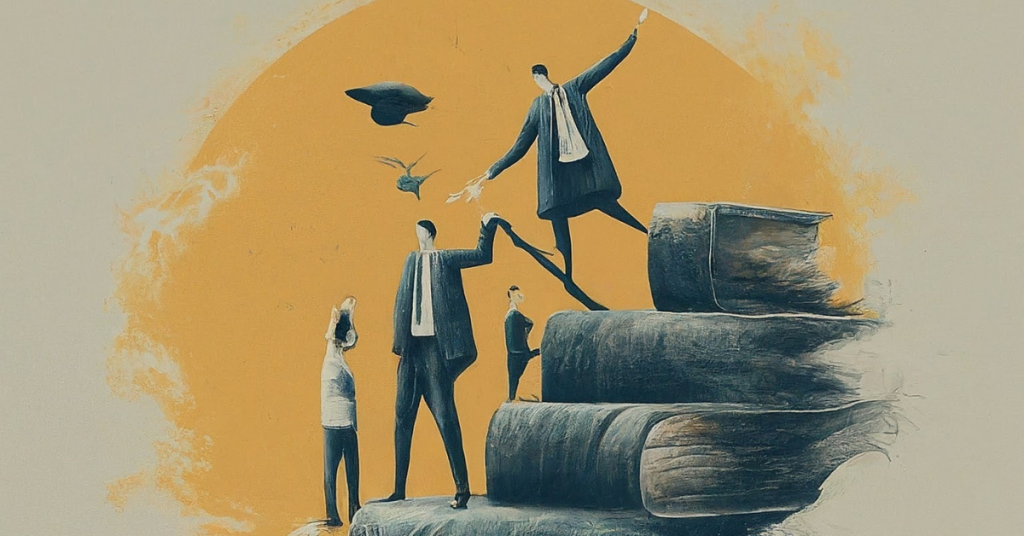
For decades, work-life balance was the ultimate goal. Keep work on one side, life on the other, and try not to let one spill into the other. That idea once made sense when jobs were predictable, offices were physical, and the day ended when you left the building. But the way we live and work has changed faster than that mantra can keep up.
Today, the boundaries between professional and personal life have become fluid. We learn through podcasts while commuting, answer messages while cooking dinner, and sign up for online courses after the kids go to bed. Work no longer sits in one corner of life. It threads through it. The question isn’t how do we keep work out of life, but how do we design a life that integrates work, learning and purpose in a healthy, human way?
That’s what work-life integration is really about — building an integrated life where meaning, learning, wellbeing and contribution coexist. It’s not about permanent connection or constant hustle. It’s about creating a natural rhythm where work supports life and life strengthens work.
Why the old work-life balance narrative no longer works
The World Economic Forum predicts that 44% of workers’ skills will be disrupted within five years, meaning almost half of what we do today will change, require reskilling, or disappear altogether (World Economic Forum 2023). At the same time, the Australian Bureau of Statistics shows that about one million Australians now hold multiple jobs — a record 6.7 per cent of the workforce (ABS 2024). These numbers tell a simple story: modern life is dynamic, overlapping, and impossible to box into neat compartments.
Technology has only accelerated this. The Microsoft Work Trend Index describes a “triple-peak day”, where activity surges in the morning, after lunch, and late at night as workers flex around care, study, or creative flow (Microsoft 2023). Flexibility, once a privilege, is now a basic expectation. The catch is that without conscious design, it morphs into an always-on lifestyle that quietly drains wellbeing.
Balance thinking assumes a strict separation between effort and rest. Integration recognises that our time, energy, and attention form one ecosystem. They don’t need walls; they need rhythm. As research on work–family enrichment shows, experiences in one role can enhance another — confidence, empathy, and skills all transfer across domains (Greenhaus & Powell 2006). The problem isn’t that work has entered our lives. It’s that we haven’t yet learned how to integrate it gracefully.

Integration is rhythm, not restriction
Traditional discussions of work-life integration often sound like upgraded balance plans — the same separation mindset, just with flexible hours. But integration isn’t about policing boundaries. It’s about designing rhythm to know when to lean in, when to recover, and how to let one sphere feed another.
The Stoic philosopher Epictetus advised focusing only on what’s within our control. We can’t control the flow of messages or market shifts, but we can design how, when, and why we engage with them. Integration means building the cadence of our days around meaning, not merely management.
Research on boundary management still matters here. People who experience a match between their preference for integration or separation and their environment report higher wellbeing and performance (Kossek et al. 2012). Yet boundaries today are fluid and often seasonal — porous during creative projects, firmer during family milestones. The healthiest people treat them as living membranes, not walls.
When work is purpose-driven, those blurred lines stop feeling like intrusion. A late-night burst of inspiration or a weekend brainstorm isn’t unhealthy if it comes from curiosity and autonomy. The harm arises when work loses coherence — when every interaction feels scattered and reactive. The antidote isn’t total disconnection but intentional flow: deep engagement followed by deliberate renewal.
Fulfilment, research suggests, can buffer strain. Studies on meaningful work link value alignment with lower burnout and higher vitality (Allan et al. 2019). Purpose doesn’t eliminate fatigue, but it transforms it into satisfaction.
Designing your natural cadence
So what does this look like day-to-day?
- Map your energy, not just your hours. Schedule demanding work when focus peaks, and use natural dips for reflection, movement, or learning.
- Embrace seasons. Some periods require immersion in career growth; others centre on family or study. Integration is elastic, not equal.
- Build rituals of transition. Instead of rigid shutdowns, use small markers — a walk, music, journaling — to help your mind switch contexts smoothly.
Integration, done well, feels like breathing: a rhythm of effort and recovery that evolves with circumstance.

Continuous self-education as a way of life
The second pillar of an integrated life is continuous learning. Skills now have a half-life. IBM estimates that technical skills expire within 2.5 years and core business skills within five (IBM 2019). Waiting for formal training is no longer an option.
But self-education isn’t just a defence against redundancy; it’s a path to holistic productivity and psychological renewal. When we’re learning, we feel movement. When we stop, stagnation sets in — often mistaken for burnout. Maslach and Leiter note that one of the biggest drivers of burnout is a mismatch of values and a loss of purpose (Maslach & Leiter 2016). Learning restores agency; it reminds us that we can still evolve.
Under the Job Demands–Resources model, learning functions as a key resource that offsets pressure and fuels engagement (Bakker & Demerouti 2017). The act of mastering something new replenishes rather than depletes energy. The Stoic Seneca captured it perfectly: “As long as you live, keep learning how to live.”
Making learning a habit
Treat learning as part of the work-life rhythm, not an extracurricular.
- Run 12-week learning sprints. Each quarter, pick one deep skill, one adjacent skill, and one meta-skill like reflection or communication.
- Pair intake with output. Write a short article, give a talk, or share lessons with your team. Teaching solidifies knowledge.
- Curate weak ties. Research shows that acquaintances — not close friends — often provide the freshest insights (Granovetter 1973). Attend a new meetup or online forum every few months.
Micro-credentials and online courses can help structure this process, but UNESCO warns that credentials without real competence risk becoming noise (UNESCO 2022). The goal isn’t collecting certificates; it’s cultivating capability.
When learning becomes woven into the fabric of daily life, it fuels both career resilience and purpose-driven living.
Purposeful interdependence
No one sustains an integrated life alone. Humans are wired for purposeful interdependence — the third pillar of integration. The Stoic thinker Hierocles imagined circles of concern expanding from self to family to community and beyond. The task, he said, is to draw those circles closer.
In modern terms, integration works best when the flows between roles strengthen relationships rather than fragment them. Strong social capital — networks of trust and reciprocity — correlates with better health, performance, and innovation (Putnam 2000; Halbesleben 2006).
Interdependence means reciprocity across domains. Family life sharpens empathy and patience that improve leadership. Work teaches problem-solving that benefits family decision-making. Community engagement provides meaning that grounds ambition. The key is reciprocity without overload — giving and receiving in proportion to energy.
Building healthy interdependence
- Design shared norms. In hybrid teams, agree on communication windows, response times, and what truly counts as urgent.
- Track the real signals of wellbeing. An Integration Scorecard can include focus-time ratio, after-hours contact rate, and boundary-fit pulse. These work wellbeing metrics create shared accountability without micromanagement.
- Protect collective recovery. The Right to Disconnect legislation in Australia formalises one part of this, but culture must follow. Encourage visible rest — leaders taking leave, teams celebrating downtime — so recovery becomes normal.
Integration doesn’t mean permanent proximity. It means alignment between your goals and those of the people and organisations around you. When the ecosystem is healthy, everyone performs better.
Burnout prevention through meaning, not withdrawal
Burnout isn’t just overwork. It’s work without coherence. Maslach and Leiter (2016) describe it as the erosion of engagement when effort no longer connects to values or purpose. The cure isn’t necessarily fewer hours; it’s better alignment.
Research confirms that meaningful work predicts engagement and wellbeing even in high-pressure environments (Allan et al. 2019). When people see how their contribution matters, stress feels purposeful rather than futile.
One of the best tools for restoring meaning is job crafting — reshaping tasks, relationships, and narratives to fit your strengths (Wrzesniewski & Dutton 2001). It can be as simple as volunteering for projects that align with your values or redefining success metrics around learning and impact instead of volume.
Purpose is renewable energy. It turns long days into meaningful investment rather than depletion. Burnout prevention starts with clarity of purpose, not avoidance of effort.
Measuring what really matters
Old management cultures measured hours. Integrated ones measure vitality. Peter Drucker’s line — “what gets measured gets managed” — still applies, but in the integrated life, the metrics change. We now track focus, learning, connection, and recovery.
A simple personal dashboard might include:
- Energy quality: How often do you finish the day energised rather than drained?
- Learning progress: What skill or insight have you advanced this month?
- Relationship depth: Have you invested time in people who expand or restore you?
- Recovery rhythm: How consistent are your rest and reflection practices?
Metrics are mirrors, not grades. They remind us where the flow is healthy and where it’s clogged. The aim is sustainable performance — a pace that’s demanding but humane.
The integrated life in practice
When these pillars align — rhythm, learning, and interdependence — work stops being an interruption to life. It becomes part of living well.
- Integrate outcomes, not hours. Let skills, insights, and relationships transfer across contexts.
- Learn continuously. Keep curiosity alive; it is the best defence against stagnation.
- Cultivate interdependence. Build relationships that replenish, not just require.
- Measure expectations. Track the conditions that support energy and purpose.
- Protect natural recovery. Rest is creative fuel, not absence of work.
The integrated life is fluid. Boundaries adjust with seasons, not guilt. Some months you lean into career growth; others you learn, parent, or heal. The test is not balance but alignment. When your work, values, and relationships move in the same direction, life feels coherent.
The future of work-life integration
This shift from balance to integration mirrors the evolution of work itself. The WHO and ILO estimate that long working hours contribute to more than 700,000 deaths each year from stroke and heart disease (Pega et al. 2021). The industrial-era rhythms of relentless output and rigid separation were never built for long-term human health.
Integration represents a course correction — not softer, but smarter. It accepts that work, learning, and life are entangled and asks how we can make that entanglement enriching instead of exhausting. For many, especially those with flexible or hybrid roles, the task is to experiment with cadence. For others — shift workers, carers, gig workers — integration will require systemic redesign so autonomy and recovery are available to everyone.
The integrated life is not a privilege. It’s the blueprint for a sustainable civilisation. When we design work to serve life, and life to enrich work, the distinction between them stops mattering so much. What remains is the rhythm of purpose.

Closing thoughts
We no longer live by the clock tower. We live by connection, curiosity, and contribution. The goal isn’t to keep work out of life but to bring life into work — to let learning, relationships, and purpose flow through everything we do.
Integration is not a destination; it’s a practice of awareness. Notice when your rhythm falters. Reset. Redesign. Over time, coherence replaces chaos. The result isn’t perfect balance but something far better: a living pattern of work, learning, and wellbeing that feels both productive and profoundly human.
Or, as Seneca might put it, no one becomes wise by accident — and no one builds an integrated life by accident either. It is designed, lived, and renewed each day.